MANSA MUSA
The story of Mansa Musa, the 14th-century Mali emperor whose legendary pilgrimage to Mecca was so lavish it crashed entire economies and put Africa on the medieval map.
Reading progress can be saved on this device. Account tools are available if you sign in.
Chapters
11 total- 01Chapter One - A Nobody in a Golden Empire
- 02Chapter Two - How to Become King Without Trying
- 03Chapter Three - Mali Was Already Rich
- 04Chapter Four - Gold Like Sand
- 05Chapter Five - The Pilgrimage That Broke the Economy
- 06Chapter Six - The Road to Mecca
- 07Chapter Seven - When Google Maps Learned His Name
- 08Chapter Eight - The Rise of Timbuktu
- 09Chapter Nine - What Happens When You Peak Too Early
- 10Chapter Ten - Musa the Man
- 11Chapter Eleven - The Richest Man on Earth
Edition notes and short pages
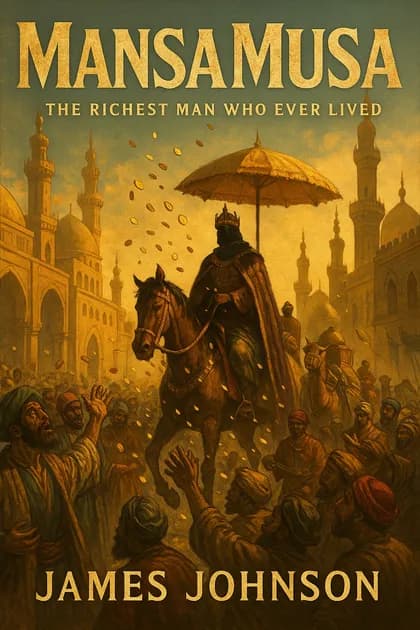
MANSA MUSA
MANSA MUSA
The Richest Man Who Ever Lived
by James Johnson
Dedication
For everyone who’s never heard his name.
ACKNOWLEDGMENTS
TO THE SILENT kings.
To the buried empires.
To the stories that got erased and the readers who bring them back.
Special thanks to the historians who kept the flame lit, even if the records were secondhand, scattered, or stolen. You made the impossible visible.
And as always, to the mirror I write in, thank you for the spark.
ABOUT THE AUTHOR
JJ WRITES MYTH-BUSTING, truth-swinging history that cuts through the fog. With over 200 books across multiple series, he tells the stories the textbooks skip. Sharp, grounded, and built to last.
His work spans empires, religions, revolutions, and lives that changed the world. You can find it all on Amazon. Just follow the gold trail.
COPYRIGHT
© 2025 JAMES JOHNSON. All rights reserved.
No part of this book may be copied, reproduced, or transmitted in any form without written permission from the publisher, except for brief quotations used in reviews or scholarship.
This work is a historical biography based on existing primary and secondary sources. While every effort has been made to ensure accuracy, some elements are interpreted or reconstructed where records are incomplete, lost, or conflicting.
This book is not affiliated with any academic institution or religious authority. It is an independent work of historical storytelling and critical analysis.