How the Bible Became the Bible
The wild historical journey of how ancient scrolls became the single most influential book in Western civilization.
Reading progress can be saved on this device. Account tools are available if you sign in.
Chapters
14 total- 01Prologue
- 02Chapter One - In the Beginning
- 03Chapter Two - Prophets, Kings, and Scribes
- 04Chapter Three - The Scroll Shelf Grows
- 05Chapter Four - From Hebrew to Greek
- 06Chapter Five - Enter: Jesus
- 07Chapter Six - Paul’s Inbox Explodes
- 08Chapter Seven - Revelation and the Rough Draft
- 09Chapter Eight - Rome Gets Involved
- 10Chapter Nine - Latin Only, Please
- 11Chapter Ten - Here Comes the Hammer: Martin Luther
- 12Chapter Eleven - The King’s English
- 13Chapter Twelve - A Thousand Versions Bloom
- 14Chapter Thirteen - Still the Bestseller
Edition notes and short pages
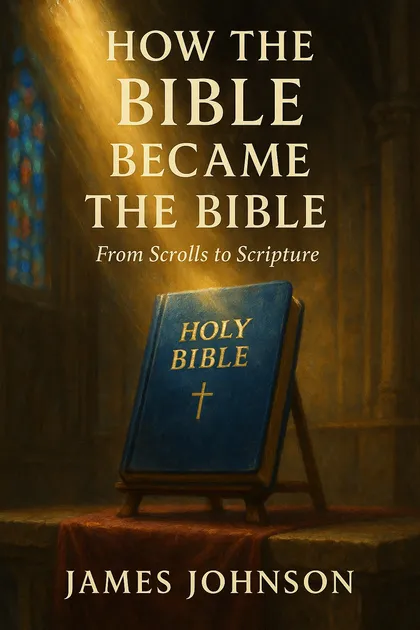
How the Bible Became the Bible
How the Bible Became the Bible
From Scrolls to Scripture
by James Johnson
Dedication
For everyone who grew up around the Bible
but never got the story behind it.
This one’s for you.
ACKNOWLEDGMENTS
THANKS TO THE countless scribes, translators, rebels, believers, and book nerds who kept the pages turning across three thousand years.
Thanks to the friends who ask questions that matter.
And thanks to the reader — for picking this up, cracking it open, and walking the shelves.
ABOUT THE AUTHOR
JJ IS THE author of over 150 books that explore history, culture, faith, power, and perception — without the fluff. He’s known for making complicated stories readable and real, cutting through the noise, and building a full library of works that stretch from ancient philosophy to modern systems of influence.
His books are available in print, digital, and free editions found at jjarchives.com
COPYRIGHT
© 2025 JAMES JOHNSON. All rights reserved.
This book is a work of nonfiction based on historical sources, scholarly research, and modern analysis. Every effort has been made to present information accurately and respectfully. This book is not intended to replace religious study, theological instruction, or personal belief.
Scripture references, when quoted or paraphrased, are used for educational and historical purposes under fair use. All trademarks and versions referenced belong to their respective holders.
No part of this book may be reproduced or distributed in any form without written permission from the publisher, except for brief quotations used in critical reviews or commentary.