
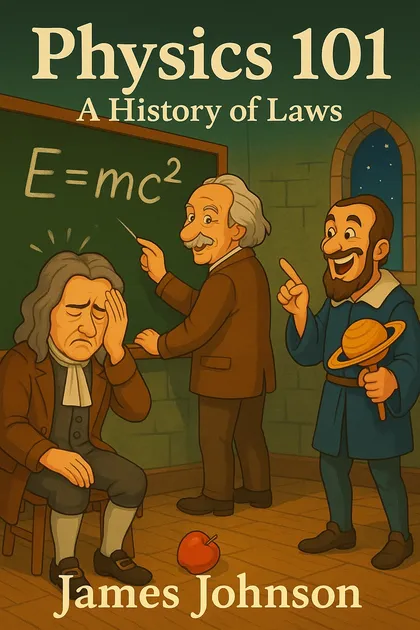
Physics 101
A narrative history of physics from Galileo to quantum mechanics, tracing how humanity discovered the fundamental laws governing reality.
Reading progress can be saved on this device. Account tools are available if you sign in.
Chapters
13 total- 01Prologue
- 02Chapter One - The First Force
- 03Chapter Two - Galileo’s Ball Drop
- 04Chapter Three - Newton Writes the Universe
- 05Chapter Four - The Machine View
- 06Chapter Five - Heat, Steam, and Entropy
- 07Chapter Six - Electric Dreams
- 08Chapter Seven - Einstein Breaks the Clock
- 09Chapter Eight - The Quantum Crack
- 10Chapter Nine - The Uncertainty Principle
- 11Chapter Ten - The Particle Zoo
- 12Chapter Eleven - The Cosmos and the Quantum
- 13Chapter Twelve - The Laws That Still Bend
Edition notes and short pages
Physics 101
Physics 101
A History of Laws
by James Johnson
Dedication
To the ones who asked “Why?” before they had words for it.
Before gravity had a name.
Before light had a speed.
Before the universe had rules.
You saw the world move and you wanted to know what moved it.
ACKNOWLEDGMENTS
THANKS TO THE wild minds who couldn’t leave it alone. From Archimedes to Einstein, Schrödinger to Maxwell, and every chaos-brained genius in between.
Thanks to the teachers who made falling apples feel like miracles, and to the rebels who questioned the obvious.
And to the ones still searching, may you never find all the answers. That’s how we keep moving.
ABOUT THE AUTHOR
JJ WRITES BOOKS that make complicated things feel like stories worth hearing. His work spans science, history, psychology, and whatever else breaks reality open just enough to let the light in.
When he’s not explaining the laws of the universe, he’s probably testing them.
COPYRIGHT
COPYRIGHT © 2025 BY James Johnson All rights reserved.
No part of this book may be copied, scanned, or distributed in any form without permission, except for brief quotes used in reviews, education, or spontaneous outbursts of awe.
This book is for educational and entertainment purposes. It simplifies, dramatizes, and occasionally messes with the seriousness of science to make the story hit harder. If you're a physicist and you’re mad about that, congratulations, you know more than the rest of us.
For everyone else:
Please don’t use this book to build a particle accelerator in your garage.
Seriously.