
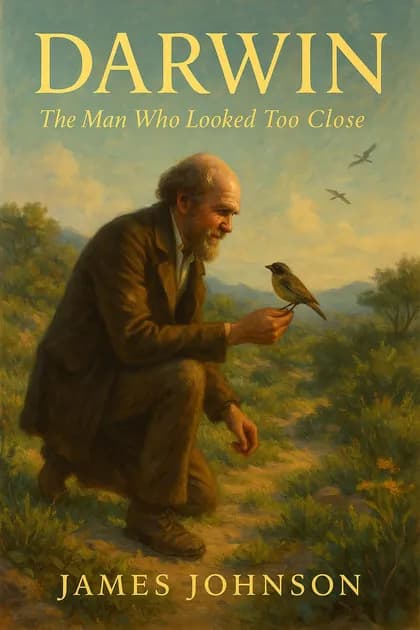
DARWIN
The story of Charles Darwin's revolutionary theory of evolution, triggered by a fever-dream letter from a rival naturalist that forced him to finally publish his world-changing secret.
Reading progress can be saved on this device. Account tools are available if you sign in.
Chapters
17 total- 01Prologue
- 02Chapter One - The Boy from Shrewsbury
- 03Chapter Two - A Gentleman Naturalist
- 04Chapter Three - The Voyage Begins
- 05Chapter Four - Earth Beneath His Feet
- 06Chapter Five - Islands, Iguanas, and Instinct
- 07Chapter Six - Nature Red in Tooth and Claw
- 08Chapter Seven - The Slow-Burn Secret
- 09Chapter Eight - Wallace Strikes the Match
- 10Chapter Nine - On the Origin of Species Explodes
- 11Chapter Ten - The Empire Reacts
- 12Chapter Eleven - Into the Human Question
- 13Chapter Twelve - Eugenics and the Misuse
- 14Chapter Thirteen - The Quiet Years
- 15Chapter Fourteen - The DNA Revolution
- 16Chapter Fifteen - Beyond Biology
- 17Chapter Sixteen - The Tree Replanted
Edition notes and short pages
DARWIN
DARWIN
The Man Who Looked Too Close
by James Johnson
Dedication
For those who couldn’t stop asking why —
even when they knew they might not like the answer.
ACKNOWLEDGMENTS
TO THE ONES who still believe in slow questions.
To the naturalists, the wanderers, the field-journal kids.
To the teachers who let evolution unfold before trying to explain it.
And to Charles Darwin — not for being right, but for being patient.
ABOUT THE AUTHOR
JJ IS THE author of over 200 books exploring the strange, brilliant, and often broken machinery behind our world. His work spans science, history, religion, and power — but always with an eye on the systems most people miss.
He writes to see the pattern.
And maybe help others see it too.
COPYRIGHT
ALL RIGHTS RESERVED. © 2025 James Johnson.
No part of this book may be reproduced, stored, or transmitted by any means without written permission from the author.
This is a work of nonfiction. While every effort has been made to accurately present historical events, scientific developments, and cultural interpretations, this book is also a narrative — built to explore the ideas behind the facts, not just the timeline.
Nothing in this book should be taken as a substitute for peer-reviewed science or academic theology. It is written for clarity, not consensus.